Job Salary Information

To enter the current salary for an employee, select the Current/Next Year Salary section in the Job Editor.

There are many elements to an employee’s salary.  It can be very straight forward, just a flat rate annual salary with no schedule and no adjustments to it or it can have many components that adjust the salary due to days worked, longevity, stipends, bonus, etc.

The Full Time Equivalent (FTE) can be used in the pay calculation only if you have set this up in Operational Settings in the Admin/Config menu as the rule to be applied to all salaries.  Otherwise, the FTE is for information only.

Contract Days and Hours per Day are used in the salary calculation and the pay per day and pay per hour calculations.

Pro-rate Days are used in the event that someone starts their job after the beginning of the fiscal year and their total salary needs to be adjusted to reflect a partial year’s salary..

Additional Days can be added if someone is to work extra days as part of their contract resulting in additional pay.  The daily rate will be multiplied by this number of days to calculate the salary impact.

Enter the Pay Type by choosing Annual, Hourly or Daily from the drop down list.

If the person is to be paid based on a salary schedule, then enter the Salary Schedule by choosing one from the drop down list.  Then by entering the Salary Step, the Contract Salary amount will display.  If the salary schedule is not in the drop down list, there may be a problem in the setup of your salary schedules.  If the person is not on a salary schedule, the schedule name should be entered as NONE.

You can adjust the salary by entering a Pay Percent.  So, if someone is working half time and is on a full-time salary schedule, then enter 0.5 as the pay percent and the salary will be reduced by half.  You can also identify whether the pay per day calculation should be adjusted accordingly by checking the box to the right of the pay percent.

A Shift Differential applies to hourly-based salaries and allows for an additional increase to the base hourly rate originally set in the salary schedule which may apply to jobs that are weekend or night shift type jobs.

There are three additional salary fields that can be used for other salary amounts that are to be added in (and their names can be customized in the Data Dictionary, if desired).  Whether it is longevity, stipends, bonuses, etc., they can be separated out for use in reports and contract letters.  You can enter the amounts directly or click on the blue, underlined field label which takes you to a new window with greater functionality for calculations.  Not only can you do a calculation to determine the amount but you have the flexibility of pulling another kind of salary schedule in such as a longevity schedule and identify a longevity step.  You can identify whether the amount is an annual, daily or hourly amount.  And with each of the salary additions, you can select whether you want it part of the Contract Amount or only part of the Total Salary.

Since there may be exceptions to the Total Salary rounding rule, you can even override the rule by indicating it in the Rounding Override field.

Salary Projections

Using the Projections section in the Fiscal menu,  you can run different salary scenarios for future years without affecting current year salary data.  Start by resetting the data to the current year and then model one or more subsequent years for the increases you want to analyze.  As you make changes, the system updates the future salary amounts in the job listing.  To do the modeling, follow these steps, performing whichever steps are applicable to your model:

  1. Search Criteria: Select the employee job assignment group that you want to model by clicking on the Select Jobs for Modeling button.
  2. Modeling Reset and Configuration:  Reset salaries to the current year by clicking on the Reset Salaries button if you are beginning the modeling process.
    Enter the fiscal year for the year you are modeling so it will print on the projection reports.
  3. Salary Schedule Changes:  Make salary schedule changes by clicking on the Edit Schedules button.  Print the revised schedule for your reference.
  4. Base Pay Changes:  Make any base changes for indexed salary schedules by clicking on the Edit Base Pay button.
  5. Salary Step Changes: Make salary step changes by entering minimum work days, if needed, and clicking on the Increase Steps+1 button.
  6. Percent Salary Increase:  Make salary percentage changes for those jobs that are not on a salary schedule by entering the percent and then clicking on the Update Salaries button.

If you have made changes but they do not appear in the listing, click on the Refresh Future Salaries button at the bottom right corner of the screen.

Click on the Future Salary Reports button and select the reports for printing to paper or pdf.  The data can also be exported to Excel by clicking on the Export Salary Summary button.

After running the model for the first year, then repeat the process for subsequent years but do not reset salaries in step 2.

Salary Schedule Reports

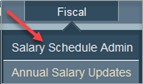
In the Salary Schedule Admin section of the Fiscal menu, there are two types of salary schedule reports.

Click on the Print Salary Schedules button to review the rates in salary schedules.  There are multiple options for viewing current year, next year, or comparison or current and next year.

Click on the Print Salary Reports button for salary schedule reports that show details or summaries of personnel on the individual schedules.

Next Year Salaries Setup Overview

The following is a checklist of steps for setting up salaries for next year:

  • Use the Salary Schedule Admin section in the Fiscal menu to update salary schedule rates and bases for next year.
  • Use the Annual Salary Updates section in the Fiscal menu to update the employee salaries.
    • Reset Salaries first for next year
    • Reset prorate days (if applicable)
    • Update work days (if applicable)
    • Increase Steps
    • Increase Additional Salary Steps (i.e. longevity, education, etc.)
    • Increase nonschedule-based salaries by percentages
    • Use the worksheets to make individual changes

If the salary schedules are updated after you started the above process, then you must click on the Refresh Salaries button to refresh the salaries for next year using the revised salary schedules.

  • When the salaries for next year are reviewed and confirmed, they are ready to be rolled over to make them show in the current year.  Check out the article on the roll over process.

Employee Salary Percentage Increase

To apply a percentage increase to salaries that are not based on salary schedules, you can enter the hand-calculated amount manually for each job or use a mass update process in the Annual Salary Updates section found in the Fiscal menu.   This process will allow you to update Next Year salaries only.  This percent increase can be for salaries that are entered as a flat annual amount or a flat hourly amount.

First use the Quick Search or Advanced Search to select the group of people and jobs that you want to update.

If you have not reset salaries for Next Year in a previous process, you will want to start by clicking on Reset SalariesThis will copy the current salary information to the Next Year salary so you have the most current baseline.
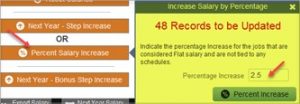
To then increase the salaries based on a percentage increase, click on Percent Salary Increase.  The system will tell you how many records will be updated.  This is a reminder to make sure you have executed a search first.

Enter the percentage increase and click Percent Increase.  You will get another confirmation message before the increase is applied.

If you need to adjust the salary or do further salary adjustments, you can either edit the individual record or, for Next Year, click on Annual Worksheets to review and make the changes.

Simple Salary Update

At any time, if you update one or more current year salary schedules and simply want to update the employee salaries that are affected by the schedule changes, go to the Annual Salary Update section of the Fiscal menu.

First use the Quick Search or Advanced Search to find the active employees and their jobs that you want updated.  If you use the Quick Search, you can select just the salary schedules that you recently updated so that you can limit your update to only those jobs affected by those schedule changes.

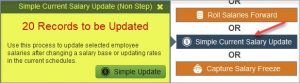
Once you confirm your selected list of jobs is correct, then click  Simple Current Salary Update and continue by clicking Simple Update. 

After the process is complete, there will be an update entry in the affected employee salary history as well as an entry in the Salary Changes History log which will indicate who ran the update, on what date and time, the number of records updated and the selected criteria.
Salary Freeze

If there is a year when no salary changes are granted, you can run a process to record/capture that the salaries were frozen for that year.  The process will generate an entry in the employee’s salary history as well as record an entry in the Salary Change History log for future reference.

This process is found in the Annual Salary Update section of the Fiscal menu.

First use the Quick Search or Advanced Search to find the active employees and their jobs that you want to capture.

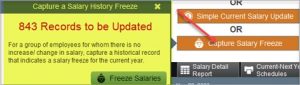
Once you confirm your selected list of jobs is correct, then click  Capture Salary Freeze and continue by clicking Freeze Salaries.


Employee Salary Rollover

If you have set up employee salary data in Next Year, then you need to roll over the data to make it for the Current Year.

Before rolling over employee salaries that have been set up in Next Year, make sure to roll over the salary schedules and salary bases first in the Salary Schedule Admin section of the Fiscal menu.
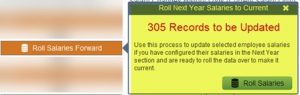
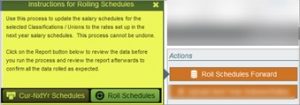
In the Annual Salary Updates section of the Fiscal menu, use the Quick Search or Advanced Search to find the active employees and their jobs that you want updated from Next Year to Current Year.  You may want to do the rollovers by individual job classifications but you do not have to.

Rates that show in red in the Next Year Salary column indicate that they are different than the Current Year and may need to be rolled over.   If you want to review the data prior to the rollover then select the print Salary Detail Report.  If you find something that needs to be changed, click on Annual Worksheets and select the Current_Next Year Salary Details worksheet.

When you are ready,  click Roll Salaries Forward.    You will then confirm that you want to roll by clicking on Roll Salaries.

Once it is complete, you will see in the listing that the data matches between current and next year and there are no rates in red.  If you see any discrepancies, you can further edit an employee’s job by clicking on the edit job icon.


Rolling Over Salary Schedules

In the Salary Schedule Admin section of the Fiscal menu, you will be able to discern if your salary bases and  rates have been updated for next year and are in need of being rolled over to the current year if they appear in red.

For schedules that are indexed-base, you will need to roll over your salary bases.  To roll one or more, click on the Manage Multiple Bases button, select the bases that you want to roll and then click on the Roll Bases button.  This copies the Next Year bases into the Current Year bases section.  The other option, if you only have one base to roll, is to edit the base and manually enter the base into the Current Year.

For schedules that are based on hourly, daily or yearly rates, you will need to click on the Roll Schedules Forward button which copies the rates that you set up in Next Year into the Current Year rates section.  To do so, first use the Quick Search to select the group of salary schedules that you want to update.  After confirming that you have the correct schedules to roll,  click Roll Schedules Forward.  If you want to review the schedules one more time, you can select the print Cur-Nx Yr Schedules option.  If you are ready to do the update, click Roll Schedules. Once the update is done, the rates will match between Current and Next Year and will no longer be red.

Employee Salary Step Increase

Although you can do the salary step increases manually for each job, there is a mass update process that is much easier and faster which is in the Annual Salary Updates section found in the Fiscal menu.   This process will allow you to update either the Current Year or Next Year steps.

First, use the Quick Search or Advanced Search to select the group of people and jobs that you want to update.

Consider the Employment Status as part of the search so that you do not give a step increase to people who may be leaving before next year or give a step increase to a new hire.  If you have used the statuses of Active-Leaving and/or New Hire, you will be able to leave that group out.  The list of jobs will show the current and next year salary data side by side for easy review.

If you are updating Next Year salary steps, you will want to start by clicking  Reset Salaries.  This will copy the current salary information to the next year salary information so you have the most current baseline.  You might notice that the salaries change based on this process if your salary schedules are different for next year.

To increase steps, click either Next Year – Step Increase if setting up your salaries first in Next Year to roll over later or Current Salary -Step Increase if you are not setting up your salaries in Next Year.   The system will tell you how many records will be updated.  This is a reminder to make sure you have executed a search first.


For increasing steps for Next Year, you can enter minimum work days so that salary steps are only incremented by one if the Current Year contract work days and the pro-rate days are greater than the minimum days you enter.  If you do not want to use minimum work days, then just leave it blank and all salary steps will be increased by one.

When ready, click Increase Steps.  The system will give you one more confirmation question before updating the steps.  You will see in the listing that the steps are increased and the salaries updated based on the step increases.

If you need to adjust the step or do further salary adjustments, you can either edit the individual record or, for Next Year, click on Annual Worksheets to review and make the changes.